The Catenians

Uncategorized

A very special celebration for Burnley Catenians

Burnley Catenians recently celebrated the baptism of **baby Francis Nnamdi**, the first baby born into a Catenian family in the Circle for several years. Francis’ parents, **Bukas and Rebecca Okey-Amechi**, both hail from Nigeria, and Bukas joined the Circle in February 2025. Francis was baptised at **St. John the Baptist Church in Padiham**, with family, friends and fellow Catenians coming together to celebrate this special milestone. A wonderful occasion — and a lovely reminder that the Catenians are about **faith, friendship and being there for one another through life’s important moments.

A very special celebration for Burnley Catenians Read More »

Autumn Is Coming. Have You Got Your People Ready?

There’s something about September that makes you realise summer has packed its bags and is heading for the door. The shorts are being folded away. The jumpers are coming out of the wardrobe. The barbecue is becoming increasingly optimistic. And somewhere in the house, someone is asking, “Where did I put my winter coat?” Before we know it, the evenings are darker, the mornings are colder and the calendar is filling up faster than you can say, “I’ll just check my diary.” But autumn isn’t all gloomy skies and soggy school runs. It’s also a time for catching up, getting organised, spending time with family, deepening our faith — and making sure we have good people around us. And that’s where being part of a Catenian Circle can make a real difference. The great seasonal wardrobe swap First things first: the summer clothes need to be washed, folded and put away until the warmer weather makes its triumphant return. The jumpers, coats and sensible shoes are coming back into circulation. It’s not glamorous, but at least you can do it while reminiscing about sunny days, holidays and the fact that you definitely wore that T-shirt enough times to justify keeping it. And as the temperature drops, having somewhere to go where you know you’ll be welcomed becomes even more important. A Catenian meeting or social event isn’t just another date in the diary. It’s an opportunity to get out, see familiar faces, meet new people, have a laugh and enjoy some genuine company. Because friendship matters all year round — but you really notice it when the nights draw in. “How are things at uni?” September also means checking in with children and grandchildren who have headed off to university. Have they settled in? Have they found their way around? Have they remembered to eat something other than toast? And, most importantly, have they worked out how the washing machine works? Whether they’re starting university, returning to school or simply navigating the next stage of life, autumn is a good reminder that family connections matter. And while we’re checking everyone else’s calendars, there’s a good chance our own are filling up too. October means more than pumpkins October is Marian Month, so it’s time to make sure the rosary beads and prayer books haven’t disappeared into the mysterious drawer where all the things you know you’ll need one day seem to live. It’s also a chance to make a little more space for prayer and reflection as the year moves towards its final months. Faith is not something we have to practise on our own, either. One of the great things about being part of a Catenian Circle is sharing faith with other Catholic men while also enjoying friendship, conversation and plenty of opportunities to get together. The family calendar is about to get serious Then there’s October half term. School dates. Parish events. Family visits. Days out. Grandparent duties. And the inevitable discussion about who is picking up whom, where everyone needs to be and whether anyone remembered to put it in the calendar. If you’re the organised one in your family, you’re probably already three steps ahead. If you’re not… Well, good luck. And then there’s the C word. Yes. Christmas. Sorry. Not sorry. For those of us who like to plan a little way ahead, September is when Christmas starts appearing on the horizon. Family plans need discussing. Food shopping slots need booking. Travel arrangements need sorting. And somebody, somewhere, will already have started buying presents. It may feel ridiculously early. But you know what happens if you leave it until December. And then there’s Confirmation… For many families, autumn also means Confirmation programmes getting underway. Dates need checking. Forms need completing. Programmes need signing up for. And parents, grandparents and young people all need to know what’s happening and when. It’s another reminder that parish life is about more than what happens on a Sunday. There are people, activities, celebrations and opportunities to get involved throughout the year. The same goes for school and parish fairs. Find out the dates. Put them in the family calendar. Get involved where you can. Because community doesn’t happen by accident. It happens when people turn up. Make room for friendship this autumn By the time you’ve sorted the wardrobe, checked on the students, organised half term, found the rosary beads, booked the Christmas shopping slot and discovered that the parish fair is also on the same weekend as everything else, you might be wondering when there’s supposed to be time for you. That’s worth thinking about. Because friendship and community shouldn’t be another thing squeezed into whatever time is left over. They’re part of what keeps us going. The Catenians bring Catholic men together through friendship, faith and mutual support — with local Circles offering opportunities to meet, socialise, support others, get involved in the community and simply enjoy spending time with good people. Autumn might mean darker evenings and colder mornings. But it doesn’t have to mean staying in and waiting for spring. Get out. Meet people. Share your faith. Have some fun. And maybe make this the autumn you find your local Catenian Circle. Ready to find out more? Visit thecatenians.uk/membership to find out how you can get involved locally, wherever you live or work.

Autumn Is Coming. Have You Got Your People Ready? Read More »

“Age is only a hurdle to be overcome”

When I decided in my 80th year to enter the 2026 Great South Run I encountered many questions including “why do it at your age”? A good point! I am not a natural runner although I have completed five London Marathons and many half marathons but that was more than two decades ago. Those marathons highlighted the generous attitude of sponsors when you take on a challenge for the benefit of a charity. I was hopeless at P. E. at school and hated cross country running so it was a great deal of effort! I have now committed to running – or rather, jogging – for two charities in need of financial support. The first is our Southampton Circle Presidents’ charity, Mountbatten Hampshire. Mountbatten provides vital palliative and end-of-life care and support to over 2,000 people every day. Around eighty-five per cent of its 24/7 compassionate support is in the homes of Hampshire residents across Southampton and large parts of the county. The remainder is provided through the inpatient unit, day services and outpatient care at the Frances Sheldon Centre, in West End, Southampton. With rising demand and ongoing funding pressures, Mountbatten Hampshire needs to raise around £10 million each year to continue its essential work. I hope you will consider giving as generously as possible. Ella Saggers, Community Fundraiser at Mountbatten, said: “Every mile Roger runs helps Mountbatten support local people and their families when they need us most.”   Ella Saggers pictured with Graham Palethorpe,President Southampton Circle The other charity is our own Catenian Bursary Fund where the need for financial support has been clearly covered by Catena and internet messages recently. I was a Trustee for this excellent initiative which reaches out to our young people. It is great to support young people going out in the world to help others. I have been very fortunate that God has given me strong hips, ankles and knees which to date have caused me no problems. Long may they last! So, why do it? To support me please use the following URL for Mountbatten Hospice: https://ajbellgreatsouthrun2026.enthuse.com/pf/roger-lillie or access using the following QR Code:     Important: Please note that a 15% commission charge is mentioned by the provider. This can be changed before payment to either remove or accept a reduced voluntary

“Age is only a hurdle to be overcome” Read More »

WeBelieve: A Jubilee Celebration of Faith at Oscott.

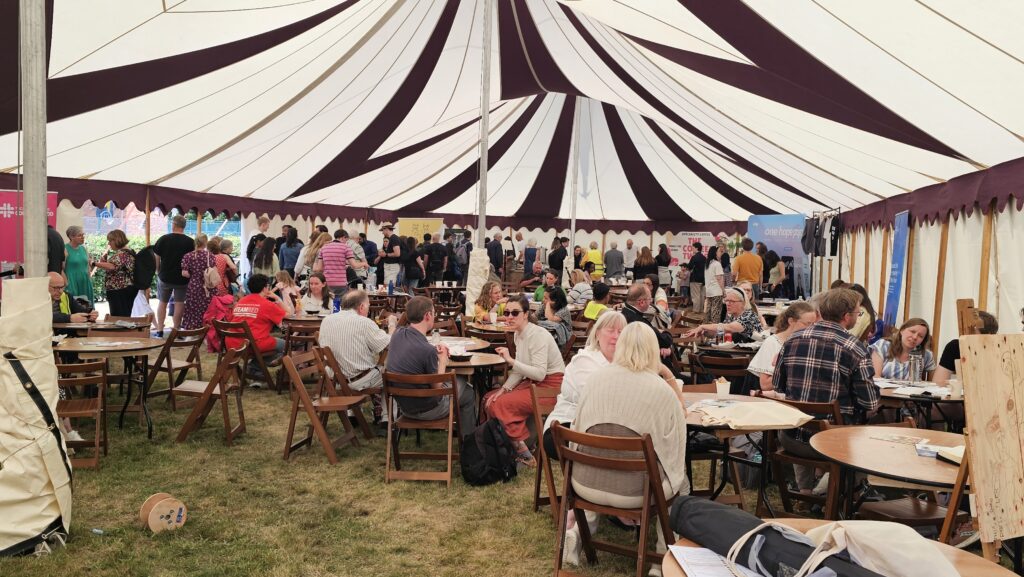
By Dave Prescott Birmingham, 25–28 July 2025 — In a jubilant convergence of devotion, diversity, and renewal, the inaugural WeBelieve Festival transformed the historic grounds of St Mary’s College Oscott into a vibrant celebration of Catholic life. Supported by the Great Britain Catenian Association and spearheaded by The Guild of Our Lady of Ransom, this four day gathering drew over 2,000 Catholics from across the nation. Families were warmly invited to camp, stay locally, or participate as day visitors—making it an accessible, welcoming space for all. WeBelieve was not merely a festival, but a living mosaic of Catholic life. Attendees experienced a number of liturgies—ranging from charismatic worship and the Latin Mass, to Syro-Malabar Vespers and the Ukrainian Divine Liturgy. A particularly poignant moment came as Archbishop John Wilson of Southwark reflected on the vision behind the festival: “My hope is that people will leave renewed in our beautiful Catholic faith and be passionate about the mission for our country… we are one.” The Catenians at the Heart of ItThe Catenian Association and our Province in particular played a vital and visible role, supporting the festival both as a partner and sponsor, and engaging directly with visitors in the Quad. Our presence underlined the values that our association brings to Catholics, especially the young Catholics. I was truly inspired by the number of young Catholics there who showed a great interest in the Catenian Association and wanted to learn more about what we do, it demonstrated to me that being a Catenian still has a great relevance particularly to young Christians which was extremely encouraging. We now need to find a way to engage with this age group and invite them along to our Circle meetings – from my experience at Oscott I am convinced that we have a wide appeal to offer these young Catholics. ….so WeBelieve marked an inspiring beginning—an opportunity to reflect on our faith and renew our commitment to Catholic life. ** Catenians in 2026 will again be sponsoring the event & will be onsite at WeBelieve Festival to answer any questions people may have about Membership. 

WeBelieve: A Jubilee Celebration of Faith at Oscott. Read More »

Pilgrimage Through the Lost Friaries of London.

by Mike Kenton, Osterley President As an avid reader of historical novels set during the Dissolution of the Monasteries, I have often wondered what remains of the religious communities that once shaped life in the City of London. Most people know Blackfriars station, but how many know why it bears that name? What traces survive of the friars who lived, worked and prayed in the City for more than 300 years? This question inspired Osterley Circle’s Walk of Faith this year. Responding to Great Britain National President Richard Mills’ invitation to undertake a pilgrimage, members set out to explore the sites of London’s medieval friaries and discover the stories hidden beneath the modern city. A pilgrimage is more than simply visiting places of religious significance. The journey itself matters. It offers time for conversation, reflection and a fresh appreciation of the people and places encountered along the way. The day began with prayers for those who died for their faith and for Pope Leo XIV, whose Augustinian roots provided a fitting connection to the theme of the walk. As we journeyed through the City, we explored the history of the great mendicant orders — the Augustinians, Dominicans, Carmelites and Franciscans. Unlike monks, friars lived and worked among the people, serving the communities around them while following lives of poverty, chastity and obedience. Although the Great Fire of London destroyed much of medieval London, the City’s street plan still reveals the footprint of the former friaries. Our first stop was Austin Friars, once home to the Augustinian friars. Today, the Dutch Church occupies part of the site, but the surrounding streets still hint at the scale of what was once one of London’s most important religious communities. Nearby stood the London residence of Thomas Cromwell, the man whose name remains forever linked with the Dissolution of the Monasteries. Along the route we followed the course of London’s hidden rivers, the Walbrook and the Fleet, both now buried beneath the streets. We paused at St Stephen Walbrook, famous as the birthplace of the Samaritans, and visited the remarkable London Mithraeum, a Roman temple hidden beneath Bloomberg’s headquarters. At Temple Church we reflected on the history of the Knights Templar, whose distinctive round church still stands as a reminder of the age of pilgrimage and crusade. The Temple later became home to the legal profession and remains one of London’s most fascinating historic enclaves. The walk continued through the former sites of Whitefriars, Blackfriars and Greyfriars. Each order left its mark on the City, whether through preaching, education or service to the poor. Their names survive in streets, stations and districts long after the friaries themselves disappeared. One of the highlights of the day was St Etheldreda’s Church in Ely Place. Dating from the 13th century, it is one of the oldest Catholic churches in London and a rare survivor from medieval England. Its connections to the martyrs of the Reformation provided a moving conclusion to the pilgrimage. By the end of the day, it was clear that while London’s friaries have largely vanished, their legacy remains woven into the fabric of the City. Their stories can still be found in its churches, street names and hidden corners. For Osterley Circle, this was more than a history walk. It was a pilgrimage in the truest sense — a journey of faith, friendship and discovery, reminding us that the past still has much to teach us if we take the time to look for it.

Pilgrimage Through the Lost Friaries of London. Read More »

Travels with Province 12

Every year or so, Swindon Catenians organize a short overseas trip for members, and this year from 9th – 12th of April some 44 members, guests and wives travelled to Arras, the prefecture of the Pas-de-Calais region. The visit was based around the First World War Battle of Arras in 1917. LE DÈPART It was a dark and blustery morning at about 5 a.m. when 44 members, wives and guests from Oxford and Ascot & Sunningdale, assemebled at various departure points to join the coach for our “away weekend” in France. For the most part the weather looked reasonable, and all were excited about the prospect of what lay ahead.  Encouraged to ‘sit back and enjoy the ride’ by our dependable chauffer, Simon, we set out for a 3½ hour trip to the Port of Dover for our channel crossing.  Despite the warnings in the Press, going through French Customas and Immigration at Dover was relatively painless and we were soon abord our ferry for the short crossing to Calais. On arrival we then left the Port for the relaxed journey to our hotel in Arras, stopping on the way at Souchez to vsit the striking new museum to the First World War.  We then travelled on to Arras and settled into our hotel. SOUCHEZ The Museum at Souchez, set in the shadow of Vimy Ridge, the scene of the great achievements of the Canadians in the battle of Arras, is most certainly well worth a visit and is of a striking new design by the architect Pierre-Louis Falouci in black concrete and glass.  It complements the French national memorial to the whole 1914-18 conflict at Notre-Damme-de-Lorette, itself set on a hillside seemingly in part suspended in the air.   For us, this visit set the scene, for it looked at the 1914-18 conflict from a multi-national viewpoint whilst the rest of our tour would naturally focus more on the Commonwealth actions and actors.    DAY 2 Our second day was bright and sunny and, after our ‘Petit-déjeuner’ we departed our hotel for a full day of visits.  As a Catholic Christian organization, our day started with our knowledgeable tour leader and guide Bertie Morris leading us in a short prayer followed by a briefing on the background to the Battle of Arras in 1917. Then, reassured that we were in capable hands, Simon, our chauffer, maneuvered his very large bus around very small French streets and coped without complaint at a seeming absence of any form of parking restriction which made maneuvering his bus very difficult.  We eventually arrived at our first destination of the day – Carrière Wellington Carrière Wellington In November 1916, the British started preparing for the 1917 spring offensive in and around Arras. Their stroke of genius: to have the New Zealand tunnellers connect up the town’s medieval chalk extraction quarries with tunnels to create a network of underground barracks, large enough to accommodate up to 24,000 soldiers, and the plan was that the attacking force would be able to hide from the enemy and appear at H- hour from the ground. As a part of the tour you all have to wear first World War steel helmets which were very heavy and most uncomfortable! COMMONWEALTH WAR GRAVES COMMISSION Then we went on to visit the Commonwealth War Graves Commission (CWGC), Visitor Centre at Beauraines which offers a behind the scenes look at how the CWGC cares for 1.7 million men and women of the Commonwealth who died during the two World Wars.  There we learnt that each year to date their work continues both in the very high standard of maintenance of the memorials, and in the identification (if possible) and interment of human remains that are still found every year.  Those who established the Commission after the First World War determined that all military cemeteries should be like “an English garden” so that our fallen would lie ‘in a corner of a foreign field that was, forever, England’. AMIENS AND THE THIEPVAL NATIONAL MEMORIAL We travelled to Amiens for a light lunch in the sunshine and many of us took the opportunity of viewing the magnificent Cathédrale Notre-Dame d’Amiens, the largest Cathedral (by volume) in France. The cathedral is situated on a slight ridge overlooking the River Somme in Amiens, the administrative capital of the Picardy region of France.  The Cathedral was built almost entirely between 1220 and 1270, an amazingly short period for such a magnificent structure. And then on the way back to our hotel in Arras we stopped at the Thiepval Memorial at the heart of the Somme battlefields. The Thiepval Memorial is the largest Commonwealth war memorial in the world, dedicated to over 72,000 British and South African soldiers with no known grave who died in the Battles of the Somme (1915–1918). Designed by Sir Edwin Lutyens and unveiled in 1932, it stands near the site of the former village which was a British target on the first day of the battle.   Several of our party were able to identify relatives whose names are inscribed on the memorial DAY 3 For Day three the party spilt into two parts – those who wished to have a rest day and “do their own thing” around Arras, and the others who wished to drive on more to look at the contribution of the ANZAC and particularly the Australians at Villers-Bretonneux. THE AUSTRALIAN NATIONAL MEMORIAL The Australian National Memorial is located across the back of the Villers-Bretonneux Military Cemetery and commemorates the Australian soldiers who served in France and Belgium during the 1914-18 conflict. The Memorial was designed by Sir Edwin Lutyens (who also designed the Thiepval Memorial) and was unveiled in 1938 by King George VI. Villers-Bretonneux became renowned on 23 April 1918 when the German advance during the Spring Offensive led to the capture of the town by German infantry and tanks. On the following day, the Australian 4th Division, supported by the Australian 5th Division, units of the

Travels with Province 12 Read More »

Steps of Hope – A Catenian Walking for Caritas

President of Wallasey Circle No 50, Pete Graham took on an unusual challenge last year. Between May and November, Pete walked from his home to all 23 Catholic churches within the Wirral Deanery areas to attend a Sunday Mass. In addition to raising money for his chosen charity Caritas-Diocese of Shrewsbury, the idea was to raise the profiles of Caritas and our own Association. “I thought it would allow me to tell a lot of people about the Catenians, in parishes where there are currently no members, whilst setting out some of the vital work our Diocese’s own charity does for young people.” While the charity supports many individuals and communities facing hardship and difficulties, Pete set out specifically to raise money to pay for support for children experiencing serious difficulties in school. “Trauma, bereavement, mental health and illness within families mean some children need specialist help, beyond the excellent pastoral care available in their local school. My wife Paula was headteacher at a local primary school and told me she had seen firsthand the life-changing impact Caritas’s support service can have on children.”  All of the churches are within 8.5 miles, but the total distance was about 84 miles, walked over 20 weekends. Pete figured the physical challenge would be significant enough for friends and family who don’t live locally or attend church to sponsor him, and that appeals in the different churches would also raise funds. That turned out to be right, with online giving raising £2,000 tbc, and the spoken appeals he was able to make in 17 of the churches raising a further £4,500. It is still possible to donate GiveTap Donation. Trish Spencer CEO of Caritas-Diocese of Shrewsbury said, “Steps of Hope worked because it was simple. One person’s idea and commitment sparked support for children and families across the Wirral. Parishes responded generously, and Peter’s conversations helped more people understand what Caritas, Catenians and parishes can achieve together.” Whilst raising the profile of our Association, Pete gathered some insights about the opportunities to recruit new members. “I’ve had the chance to speak to over 1,000 parishioners and I estimate that includes over 300 men. In many of the churches, there were no active members of our Association, which means there are significant opportunities for recruitment beyond our current member’s parishes. Pete has shared his observations with the neighbouring Circles on the Wirral (Birkenhead No 69 and Ellesmere Port No 273) and discussed the initiative with Brothers across Province 4. From a personal point of view Pete and his wife Paula, who accompanied him on most of the walks, found it was a rare opportunity to worship in other churches. Like many of other Catenian couples they are busy with their own parish almost every Sunday. Pete chronicled the project with photos and music on Instagram (@petegraham) “It was really inspiring to experience such a warm welcome, and to witness the generosity of Catholics in the different churches. We also picked up some nice ideas we have taken back to our own parish!” said Paula.   Photos: Fundraising Poster, Caritas Logo, Montage of the churches and Strava images, photo of Pete at St Joseph’s Seacombe.

Steps of Hope – A Catenian Walking for Caritas Read More »

Following in the footsteps of Saint Columba

On the back of the success of our 2024 pilgrimage following in the steps of St Cuthbert to the Holy Island of Lindisfarne plans are afoot for the Catenians to make a pilgrimage in 2026 that will follow in the footsteps of St Columba on the Islands of Iona and Mull.  The Isle of Iona Lying off the west coast of the Isle of Mull the tiny Isle of Iona, barely three miles long by one mile wide, has had an influence out of all proportion to its size on the establishment of Christianity in Scotland, England and throughout mainland Europe Iona’s place in history was secured in 563 AD when St. Columba, an Irish Monk, made the hazardous crossing from Ireland and arrived on its white sandy beaches with 12 followers, to established his mission.  On the island he built his first Celtic church and established a noted monastic community.  St Cuthbert, whose missionary way we followed last year from Melrose in Scotland to the Holy Island of Lindisfarne, was a missionary member of that Celtic Christian community. Once settled, Columba set about converting most of pagan Scotland and northern England to the Christian faith.  Iona’s fame as a Celtic Christian missionary centre and outstanding place of learning eventually spread throughout all of Europe, turning the island and its monastery into a place of pilgrimage for several centuries to come. Iona became a sacred isle where kings of Scotland (48), Ireland (4) and Norway (8) were buried. Saint Columba Saint Columba (7 December 521 – 9 June 597) was an Irish abbot and missionary credited with spreading Christianity in present-day Scotland, and through his missionary disciples to most of northern Engalnd. He founded the important abbey on Iona, which became a dominant religious and political institution in the region for centuries. He is the Patron Saint of Derry. He was highly regarded by both the Gaels of Dál Riata and the Picts, and is remembered today as a Christian saint and one of the Twelve Apostles of Ireland. Columba reportedly studied under some of Ireland’s most prominent church figures and founded several monasteries in the country. Around 563 he and his twelve companions crossed to Dunaverty near Southend, Argyll in Kintore before settling in Iona in Scotland, then part of the Irish kingdom of Dál Riata, where they founded a new abbey as a base for spreading Christianity among the northernPictish kingdoms who were pagan. He remained active in Irish politics, though he spent most of the remainder of his life in Scotland. Three surviving early medieval Latin hymns may be attributed to him Vita Columbae The main source of information about Saint Columba’s life is the Vita Columbae (i.e. “Life of Columba”), a hagiography written in the style of “saint’s lives” narratives that had become widespread throughout medieval Europe. Compiled and drafted by scribes and clergymen, these accounts were written in Latin and served as written collections of the deeds and miracles attributed to the saint, both during his or her life or after death. The canonization of a saint, especially one who had lived on the fringes of the medieval Christian world like Saint Columba, required a well-written hagiography to be submitted to Rome to gain approval from the Catholic Church The Isle of Mull The Pilgrimage The pilgrimage, like the previous walking pilgrimage to Lindisfarne, will take the form of an 6-8 day period walking around Iona and Mull to visit all the important sites.  As there is no formal walking route across the island of Mull, plans are being developed to arrange two days of walking in Oban area, three days walking on the island of Mull from a base in the town of Tobermory and the two final days on the Holy island of Iona where St Columba was based during his missionary journeys. Due to the difficulty of acquiring sufficient accommodation on Iona for those wishing to participate a provisional booking of six double and six single rooms at the Argyle Hotel has been made on Iona for two nights for the nights of 21st & 22nd April 2027 The Pilgrimage is a walking pilgrimage and will require stamina and fitness. How to express an interest? If members or their families are interested in joining the group for any part of the walk especially the section on Iona then please could they let pilgrimage organizer Andrew Sowerby know as soon as possible so the bookings can be confirmed and the detailed planning can take place. Circle Secretaries will be able to provide Andrew’s Email address. Please place the date of the pilgrimage in your diary now and let Andrew know of your interest as soon as possible.

Following in the footsteps of Saint Columba Read More »

LEST WE FORGET

Catenian Memorial at the National Arboretum – David Rowley – Past Great Britain National President with his family. As we approach November 11th, our thoughts turn to those brave men and women who gave their lives in conflicts. This week, Eileen and I visited the National Memorial Arboretum which is not too far from where we live. Our main focus was to remember my grandfather George Henry Rowley who was killed on the Somme in the first world war. As we walked down the vast central drive of the Arboretum, the trees were showing their Autumn colours. We passed the new memorial dedicated by the King only this week. On the left an army of people were putting together a massive garden of remembrance with hundreds, maybe thousands of crosses in the shape of a giant poppy. We have been to the Arboretum many times but on this occasion we both felt very moved by the scene. It truly is a marvellous place. Then, walking by the river, we were soon able to see the striking Catenian Memorial nestling on the edge of the trees. What impresses me most about our memorial is how pristine it always looks. This is down to Allan, our stonemason who designed it to be self cleaning requiring very little maintenance. We duly paid our respects to grandfather George, also remembering his wife Mary and two young children whose lives were devastated by his loss. At the same time we remembered all those Catenians and their families similarly affected. It was also an opportunity to pray for all those we had lost within the family and many Catenians. I also got to thinking of the significance of this memorial as something permanent which symbolises our Association as a beacon of friendship and support. If you haven’t been to the Arboretum, it is easy to find just off the A38 between Lichfield and Derby. There are lots of brown signs, A moving day and may all those we remember rest in peace. Catenian Memorial at the National Arboretum – Eileen Rowley

LEST WE FORGET Read More »

Bath Circle President’s Sunday

It was a wet start to Bath Circle President’s Sunday when some 35 members, partners and guests gathered with Bath President Gervase O’Donovan and his wife Sue at the fabulous Basilica of St Gregory the Great, better known as Downside Abbey, in Somerset, home to the adjacent famous Downside Catholic Public School. Downside Abbey is the senior Benedictine monastery of the English Benedictine Congregation. Originally founded in Douai, in 1606, the community of St Gregory the Great settled at Downside in Somerset in 1814.  Within a decade the community had adjusted to their life at Downside, and by 1823 had opened a chapel and new school buildings; designed by Henry Goodridge in the Gothic style to recall medieval monastic life. Members and their friends gathered to hear a most beautiful mass said for us by the Abbot of Downside, the Right Reverend DOM Nick Wetz, OSB. Sadly, the monastic congregation at Downside has now moved to Belmont Abbey in Herefordshire, but we were pleased to learn that the Abbey will continue to be used as a church and place of worship for both the adjacent public school and local congregation for years to come. Singing was accompanied by the Abbey Church’s magnificent great organ, one of the finest examples of John Compton’s work.  Dating from 1931, and therefore a fairly early instrument it has all the typical Compton tonal flare and innovation that had already become his trademark. The tone is helped by the Abbey’s very generous acoustic which in turn lends grandeur to the sound and makes for both a magical and moving experience for the listener.After Mass the party, accompanied by Abbot Nick, repaired to the Holcombe Inn, a local restaurant, for a delightful and excellent lunch.  In true fashion, late morning, the rain departed – the sun came out – and all was well with the world.

Bath Circle President’s Sunday Read More »

Scroll to Top