The Catenians

Author name: The Catenians

WeBelieve: A Jubilee Celebration of Faith at Oscott.

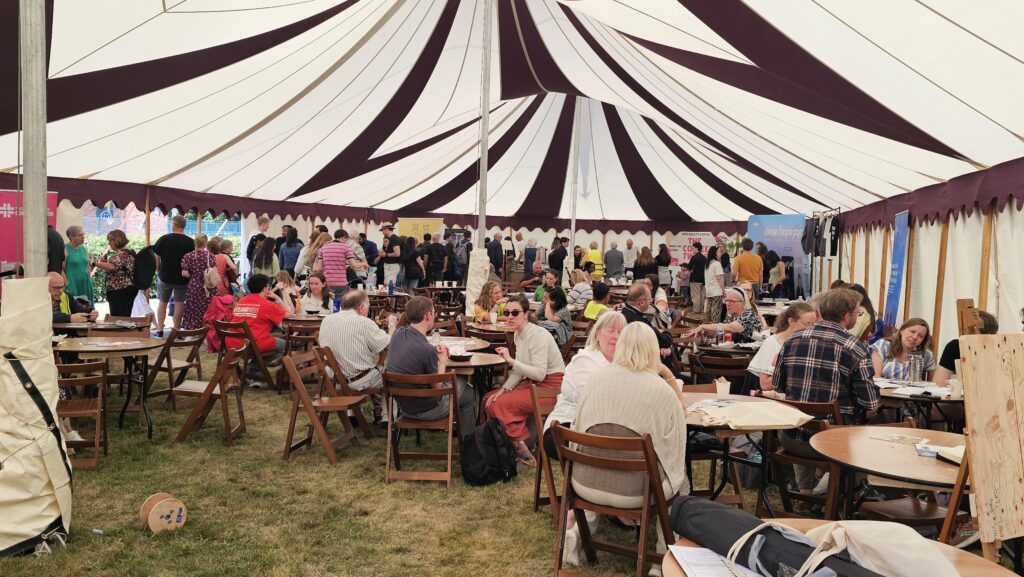
By Dave Prescott Birmingham, 25–28 July 2025 — In a jubilant convergence of devotion, diversity, and renewal, the inaugural WeBelieve Festival transformed the historic grounds of St Mary’s College Oscott into a vibrant celebration of Catholic life. Supported by the Great Britain Catenian Association and spearheaded by The Guild of Our Lady of Ransom, this four day gathering drew over 2,000 Catholics from across the nation. Families were warmly invited to camp, stay locally, or participate as day visitors—making it an accessible, welcoming space for all. WeBelieve was not merely a festival, but a living mosaic of Catholic life. Attendees experienced a number of liturgies—ranging from charismatic worship and the Latin Mass, to Syro-Malabar Vespers and the Ukrainian Divine Liturgy. A particularly poignant moment came as Archbishop John Wilson of Southwark reflected on the vision behind the festival: “My hope is that people will leave renewed in our beautiful Catholic faith and be passionate about the mission for our country… we are one.” The Catenians at the Heart of ItThe Catenian Association and our Province in particular played a vital and visible role, supporting the festival both as a partner and sponsor, and engaging directly with visitors in the Quad. Our presence underlined the values that our association brings to Catholics, especially the young Catholics. I was truly inspired by the number of young Catholics there who showed a great interest in the Catenian Association and wanted to learn more about what we do, it demonstrated to me that being a Catenian still has a great relevance particularly to young Christians which was extremely encouraging. We now need to find a way to engage with this age group and invite them along to our Circle meetings – from my experience at Oscott I am convinced that we have a wide appeal to offer these young Catholics. ….so WeBelieve marked an inspiring beginning—an opportunity to reflect on our faith and renew our commitment to Catholic life. ** Catenians in 2026 will again be sponsoring the event & will be onsite at WeBelieve Festival to answer any questions people may have about Membership. 

WeBelieve: A Jubilee Celebration of Faith at Oscott. Read More »

Following in the footsteps of Saint Columba

On the back of the success of our 2024 pilgrimage following in the steps of St Cuthbert to the Holy Island of Lindisfarne plans are afoot for the Catenians to make a pilgrimage in 2026 that will follow in the footsteps of St Columba on the Islands of Iona and Mull.  The Isle of Iona Lying off the west coast of the Isle of Mull the tiny Isle of Iona, barely three miles long by one mile wide, has had an influence out of all proportion to its size on the establishment of Christianity in Scotland, England and throughout mainland Europe Iona’s place in history was secured in 563 AD when St. Columba, an Irish Monk, made the hazardous crossing from Ireland and arrived on its white sandy beaches with 12 followers, to established his mission.  On the island he built his first Celtic church and established a noted monastic community.  St Cuthbert, whose missionary way we followed last year from Melrose in Scotland to the Holy Island of Lindisfarne, was a missionary member of that Celtic Christian community. Once settled, Columba set about converting most of pagan Scotland and northern England to the Christian faith.  Iona’s fame as a Celtic Christian missionary centre and outstanding place of learning eventually spread throughout all of Europe, turning the island and its monastery into a place of pilgrimage for several centuries to come. Iona became a sacred isle where kings of Scotland (48), Ireland (4) and Norway (8) were buried. Saint Columba Saint Columba (7 December 521 – 9 June 597) was an Irish abbot and missionary credited with spreading Christianity in present-day Scotland, and through his missionary disciples to most of northern Engalnd. He founded the important abbey on Iona, which became a dominant religious and political institution in the region for centuries. He is the Patron Saint of Derry. He was highly regarded by both the Gaels of Dál Riata and the Picts, and is remembered today as a Christian saint and one of the Twelve Apostles of Ireland. Columba reportedly studied under some of Ireland’s most prominent church figures and founded several monasteries in the country. Around 563 he and his twelve companions crossed to Dunaverty near Southend, Argyll in Kintore before settling in Iona in Scotland, then part of the Irish kingdom of Dál Riata, where they founded a new abbey as a base for spreading Christianity among the northernPictish kingdoms who were pagan. He remained active in Irish politics, though he spent most of the remainder of his life in Scotland. Three surviving early medieval Latin hymns may be attributed to him Vita Columbae The main source of information about Saint Columba’s life is the Vita Columbae (i.e. “Life of Columba”), a hagiography written in the style of “saint’s lives” narratives that had become widespread throughout medieval Europe. Compiled and drafted by scribes and clergymen, these accounts were written in Latin and served as written collections of the deeds and miracles attributed to the saint, both during his or her life or after death. The canonization of a saint, especially one who had lived on the fringes of the medieval Christian world like Saint Columba, required a well-written hagiography to be submitted to Rome to gain approval from the Catholic Church The Isle of Mull The Pilgrimage The pilgrimage, like the previous walking pilgrimage to Lindisfarne, will take the form of an 6-8 day period walking around Iona and Mull to visit all the important sites.  As there is no formal walking route across the island of Mull, plans are being developed to arrange two days of walking in Oban area, three days walking on the island of Mull from a base in the town of Tobermory and the two final days on the Holy island of Iona where St Columba was based during his missionary journeys. Due to the difficulty of acquiring sufficient accommodation on Iona for those wishing to participate a provisional booking of six double and six single rooms at the Argyle Hotel has been made on Iona for two nights for the nights of 21st & 22nd April 2027 The Pilgrimage is a walking pilgrimage and will require stamina and fitness. How to express an interest? If members or their families are interested in joining the group for any part of the walk especially the section on Iona then please could they let pilgrimage organizer Andrew Sowerby know as soon as possible so the bookings can be confirmed and the detailed planning can take place. Circle Secretaries will be able to provide Andrew’s Email address. Please place the date of the pilgrimage in your diary now and let Andrew know of your interest as soon as possible.

Following in the footsteps of Saint Columba Read More »

LEST WE FORGET

Catenian Memorial at the National Arboretum – David Rowley – Past Great Britain National President with his family. As we approach November 11th, our thoughts turn to those brave men and women who gave their lives in conflicts. This week, Eileen and I visited the National Memorial Arboretum which is not too far from where we live. Our main focus was to remember my grandfather George Henry Rowley who was killed on the Somme in the first world war. As we walked down the vast central drive of the Arboretum, the trees were showing their Autumn colours. We passed the new memorial dedicated by the King only this week. On the left an army of people were putting together a massive garden of remembrance with hundreds, maybe thousands of crosses in the shape of a giant poppy. We have been to the Arboretum many times but on this occasion we both felt very moved by the scene. It truly is a marvellous place. Then, walking by the river, we were soon able to see the striking Catenian Memorial nestling on the edge of the trees. What impresses me most about our memorial is how pristine it always looks. This is down to Allan, our stonemason who designed it to be self cleaning requiring very little maintenance. We duly paid our respects to grandfather George, also remembering his wife Mary and two young children whose lives were devastated by his loss. At the same time we remembered all those Catenians and their families similarly affected. It was also an opportunity to pray for all those we had lost within the family and many Catenians. I also got to thinking of the significance of this memorial as something permanent which symbolises our Association as a beacon of friendship and support. If you haven’t been to the Arboretum, it is easy to find just off the A38 between Lichfield and Derby. There are lots of brown signs, A moving day and may all those we remember rest in peace. Catenian Memorial at the National Arboretum – Eileen Rowley

LEST WE FORGET Read More »

The Icon of Our Lady of Victories

On the 7th October 2025 a party of Catenians led by Great Britain National President Gerry McCormack, joined with our friends the Defence Catholic Military Association (CMA) and the charity Aid to the Church in Need at the Defence Catholic Cathedral Church of St Michael and George at Aldershot for a service of blessing and dedication of the CMA’s new icon of their patroness, Our Lady of Victories. The icon From its establishment in 2018, the CMA has had Our Lady of Victories as its spiritual patroness. Since its inception the CMA has been looking to acquire a suitable visual representation of Our Lady of Victories – but they are hard to find.  So, a plan was devised to commission the world’s very first icon to her.  Knowing of the school of Eastern Catholic Iconographers in the Ukraine, the CMA approached the charity, Aid to the Church in Need, to seek their help as facilitators to help arrange the commission. Contact was established through a Ukrainian intermediary, but the war currently raging in the country made things very difficult.  After many setbacks, trials and dangers, the Icon was eventually commissioned and written by the iconographers, working under wartime conditions of great risk and danger.  They used traditional egg-tempera and gold on a wooden base to produce the wonderful icon.  Eventually, in what was itself a miraculous journey, that was fraught with difficulty and danger, the completed icon was transported out of the Ukraine and delivered to the Ukrainian Catholic Church in the UK. What the icon writers have written will endure both as a testament to their skill, prayerfulness, dedication and bravery and to the close and enduring relationship that has been established between the British and Ukrainian armed forces.  The icon will act as a symbol of the common dedication and veneration of both the British and Ukrainian people for Our Lady. Catenian involvement The Icon cost a considerable sum to procure, most of which was raised by the CMA members themselves who conducted a crowd-funding initiative, but, knowing of the support of the Catenian Association, the CMA invited the Catenians to help.  Working through Roger Lillie, the past National President who signed the Associations memorandum of affiliation with the CMA, individual Catenians, particularly those with a personal connection with HM Armed Forces, were asked to consider making a personal donation, and so the necessary funds were provided. Pictured are Captain Francis Osborn, Chair of the CMA, and Gerry McCormack, Great Britain President of the Catenian Association. What is an Icon? Icons are representations of the Heavenly. They are expressions of Orthodox Faith, teaching, and worship. Therefore, Icons are not drawings or creations of imagination. They are in fact writings of things not of this world. Orthodox icons, unlike Western pictures, change the perspective and form of the image so that it is not naturalistic. This is done so that we can look beyond appearances of the world, and instead look to the spiritual truth of the holy person or event. Icons can only be created with the blessing of the Church, as they are writings of Truth, created prayerfully – indeed, the very act of their creation is a prayer. Purpose of Icons The Orthodox Church uses icons to assist in worship. Icons are a ‘window to heaven’ and they help us to focus our thought on the divine things. While the icons still contain material aspects, like paint and colour, we are taught not to reject our physical life but instead to transform it, as was done by the holy people represented by the icons. It is important to note that the icons themselves are venerated only, not worshipped; we only worship God in the Holy Trinity (Father, Son, and Holy Spirit). The service of Blessing and Dedication The Icon was blessed and dedicated by the Right Reverend Kenneth Nowakowski, OBE, Eparchial Bishop of the Ukrainian Catholic Eparchy of the Holy Family, London, and The Right Reverend Paul Mason, Bishop-in-Ordinary to His Majesty’s Armed Forces. The service of Blessing of the icon was held in the Defence Catholic Cathedral in Aldershot, and led by the Bishop-in-Ordinary to HM Armed Forces, the Right Reverend Paul Mason. The icon itself was blessed by the Eparchial Bishop of the Ukrainian Catholic Eparch of the Holy Family, The Right Reverend Kenneth Nowakowski OBE. After a reading from the Book of the Apocalypse, Chapter 12, verses 1-9, Bishop Paul in his homily reflected on the figure of Mary – not as a meek, mild and mourning figure, but as a warrior who cast out Satan and opened the gates of heaven.  Truly an apt patroness for the CMA.    In Blessing the icon, Bishop Ken prayed  “ … as we look upon the likeness with the eyes of the body, we may with the eyes of the mind meditate upon her holiness and be led to imitate her deeds.” The future The permanent home of the Icon will be in the Defence Catholic Cathedral in Aldershot, but in the immediate future the Icon is set to tour UK defence establishments around the world, so that it can be seen and venerated by serving Catholics in the military, wherever their service takes them. All images credit to Albert Rhodes.

The Icon of Our Lady of Victories Read More »

Bath Circle President’s Sunday

It was a wet start to Bath Circle President’s Sunday when some 35 members, partners and guests gathered with Bath President Gervase O’Donovan and his wife Sue at the fabulous Basilica of St Gregory the Great, better known as Downside Abbey, in Somerset, home to the adjacent famous Downside Catholic Public School. Downside Abbey is the senior Benedictine monastery of the English Benedictine Congregation. Originally founded in Douai, in 1606, the community of St Gregory the Great settled at Downside in Somerset in 1814.  Within a decade the community had adjusted to their life at Downside, and by 1823 had opened a chapel and new school buildings; designed by Henry Goodridge in the Gothic style to recall medieval monastic life. Members and their friends gathered to hear a most beautiful mass said for us by the Abbot of Downside, the Right Reverend DOM Nick Wetz, OSB. Sadly, the monastic congregation at Downside has now moved to Belmont Abbey in Herefordshire, but we were pleased to learn that the Abbey will continue to be used as a church and place of worship for both the adjacent public school and local congregation for years to come. Singing was accompanied by the Abbey Church’s magnificent great organ, one of the finest examples of John Compton’s work.  Dating from 1931, and therefore a fairly early instrument it has all the typical Compton tonal flare and innovation that had already become his trademark. The tone is helped by the Abbey’s very generous acoustic which in turn lends grandeur to the sound and makes for both a magical and moving experience for the listener.After Mass the party, accompanied by Abbot Nick, repaired to the Holcombe Inn, a local restaurant, for a delightful and excellent lunch.  In true fashion, late morning, the rain departed – the sun came out – and all was well with the world.

Bath Circle President’s Sunday Read More »

Stop Press!!  WeBelieve Festival 2025

The Great Britain Catenian Association is a partner and sponsor of the We Believe Festival, which will take place in the beautiful grounds of St Mary’s College, Oscott, Chester Road, Sutton Coldfield B73 5AA from the 25th to the 28th of July 2025. The Festival is a Festival of Catholic Life celebrating the Jubilee Year of Hope. This is a festival for all the family and is sure to attract families from all over the country.  Come and join us in building something brand new!  Be part of an inspiring journey as we create a space filled with faith, hope, and charity. From contributing your talents, to sharing the festival with others, there’s a place for everyone to help shape this unique experience. Together, let’s make this Jubilee Year unforgettable. The principal organisers of the WeBelieve Festival are the Guild of Our Lady of Ransom Established in 1887, the Guild has been working for the evangelisation of England & Wales for over a century and counts amongst its founder members the then Archbishop of Westminster, Cardinal Manning, and St. John Henry Newman.  More recently the Guild was instrumental in the work to canonize St John Henry Newman and the re-dedication of England as Mary’s Dowry. Today the Guild continues to live out its mission building upon its traditional support for parishes and innovative ideas. The Guild gives this support to those in need through grants, partnerships and resourcing. The Festival will take place in the beautiful grounds to St Mary’s seminary, Oscott. The seminary at Oscott has its roots in the Victorian revival of Catholicism, and ordained its first priest in 1805. The college buildings that exist today were purpose-built and opened in 1838 The beating heart of the life of the college, its chapel, is also a masterwork of the architect Augustus Welby Pugin who believed that beautiful sacred spaces had the power to stir people’s imagination and inspire them to find God in prayer and worship. So, do come along to join us at the Festival – and bring the whole family. Come and meet the Catenians at our stand in the Expo Marquee, and there’ll be lots and lots more to do for all the family.   Those that wish to have the opportunity to embrace the full festival experience can catch the early-risers and after-hours content by camping on either the general or family campsites. Full details, the Festival programme and a ticket application form can be found on the festival website

Stop Press!!  WeBelieve Festival 2025 Read More »

50 Years in the saddle – and still loving it!

Riding a motorbike is an activity that provides a unique experience for riders, as it combines risk with freedom and fun. The adrenaline rush associated with motorcycling can be attributed to riding a machine at high speeds increases the body’s heart rate, breathing rate, and alertness.  Catenian Dave Prescott, a dedicated biker, tells us all about it

50 Years in the saddle – and still loving it! Read More »

Public Speaking

For those of you that don’t know, It’s that time of the year when Provinces up and down the country organise Public Speaking competitions for Catholic Sixth Formers. In our modern world it is essential that young people equip themselves with the skills to communicate confidently, clearly and effectively.  To this end, and organised by local Catenians together with the teachers, family and friends of the entrants in the competition, we are encouraging Catholic schools and colleges across the UK to participate in this important event.  The Catenian Association National Public Speaking Competition invites students to speak for four minutes for a chance of winning £200 for their school’s charity fund and perhaps to include their participation on their CV for university and their future employment. Each participant will receive a Certificate of Participation and the winner and runners up will each receive a cash prize and a Certificate of Achievement. For more information click here: contactus@thecatenians.com

Public Speaking Read More »

Scroll to Top